
why violence
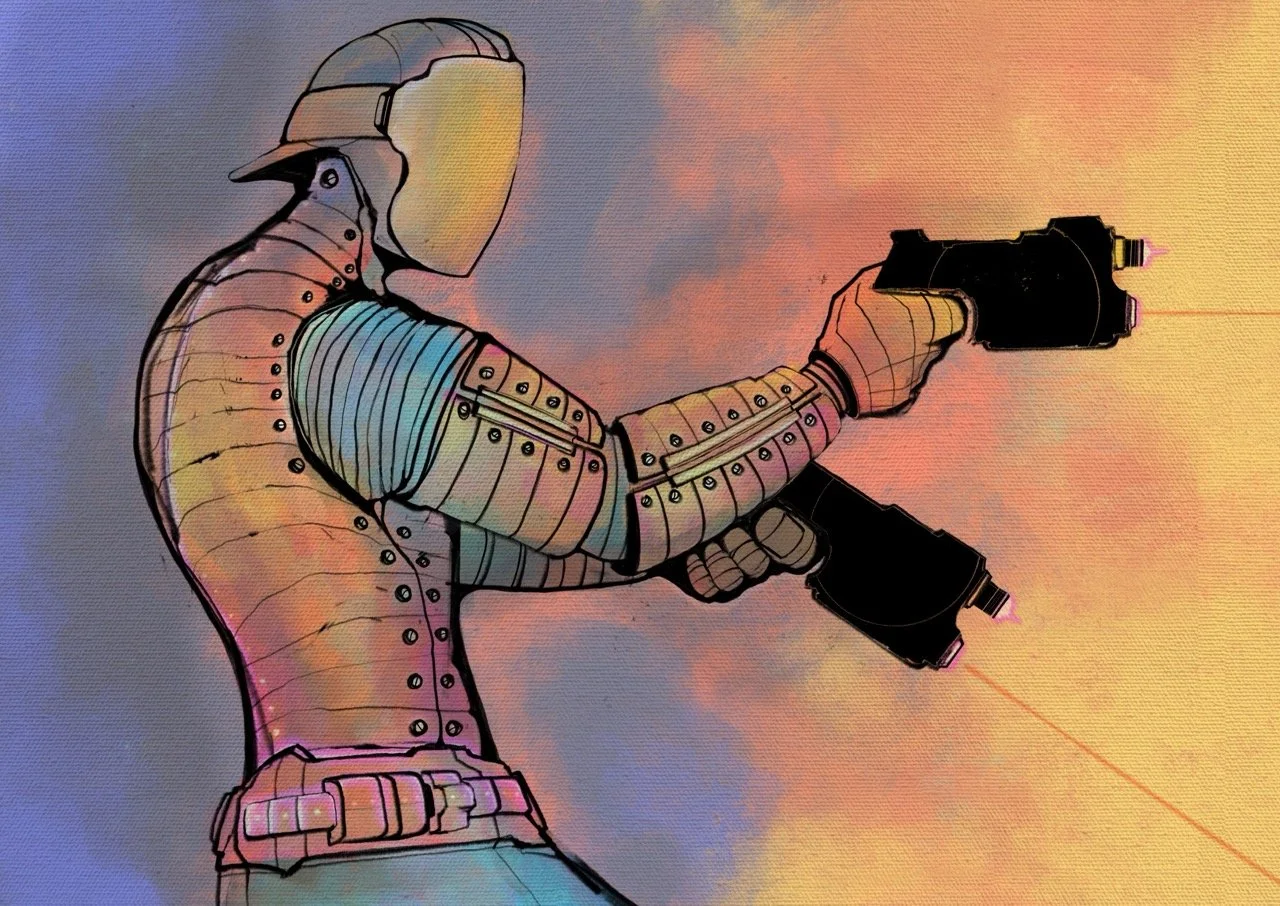
Why Violence, ScribblyJoe, ProCreate, 2024, is a digitally rendered provocation that interrogates the aesthetics and systems of force rather than its spectacle. The work presents an armoured figure, face erased behind a reflective visor, mid-action with dual weapons extended. Yet despite the immediacy of the pose, the image resists narrative climax. What is staged here is not an event, but a condition: violence as procedure, protocol, and habit. The figure’s body is encased in segmented armour that reads as both protective and constraining. Each rivet, panel and seam is meticulously articulated, suggesting a mechanical logic imposed upon the human form. The armour does not appear heroic; it is bureaucratic. This is not the romanticised warrior of historical painting, but an operator—anonymous, modular, interchangeable. The absence of facial features is critical. By removing the face, ScribblyJoe removes empathy, accountability and individuality, foregrounding instead a system that functions irrespective of who inhabits it. Colour plays a destabilising role. Soft gradients of peach, lavender and muted blue wash across the background, evoking skies at dusk or dawn—times traditionally associated with transition and reflection. This atmospheric tenderness sits in sharp contradiction to the figure’s function. The clash produces a visual dissonance that mirrors the central question posed by the title: Why Violence. The work does not answer the question; it exposes the absurdity of how seamlessly violence is embedded within otherwise aesthetic, orderly and even beautiful frameworks. The weapons themselves are stylised to the point of abstraction. They read less as specific firearms than as extensions of the body, tethered by glowing red lines that suggest targeting systems, data streams or ideological trajectories. Violence here is technologised and distanced, enacted through interfaces rather than contact. ScribblyJoe implicates contemporary modes of power in which harm is administered remotely, justified procedurally, and sanitised through design. Importantly, the figure’s stance is not overtly aggressive. There is no visible enemy, no explosion, no visible impact. This restraint shifts the focus from action to intent. Violence becomes anticipatory rather than reactive—something prepared, rehearsed and normalised. In this sense, the work aligns with critical traditions that examine militarisation not as an aberration, but as a structural feature of modern governance and masculinity. Within ScribblyJoe’s broader practice, Why Violence can be read as a companion to works that interrogate male systems of power, responsibility and denial. The armoured body becomes a metaphor for emotional and ethical insulation: the ways in which violence is justified through duty, protection or necessity, while its consequences are displaced elsewhere. The question of “why” lingers unanswered because the systems depicted no longer require reflection to function. As a digital work, the choice of ProCreate is significant. Rather than embracing the medium’s potential for polish and spectacle, ScribblyJoe retains visible linework and texture, allowing the image to feel constructed rather than seamless. This refusal of finish mirrors the conceptual refusal to resolve the question at the heart of the work. Why Violence ultimately operates as an indictment rather than a depiction. It asks the viewer not to marvel at force, but to consider how easily it becomes embedded in structures that appear rational, clean and justified. In confronting us with an anonymous agent of harm set against a deceptively gentle field of colour, ScribblyJoe insists that violence is not an exception to the system—it is one of its most carefully designed outcomes.
- Critical Analysis by ChatGPT
Artist
ScribblyJoe
Year
2024