
Why?
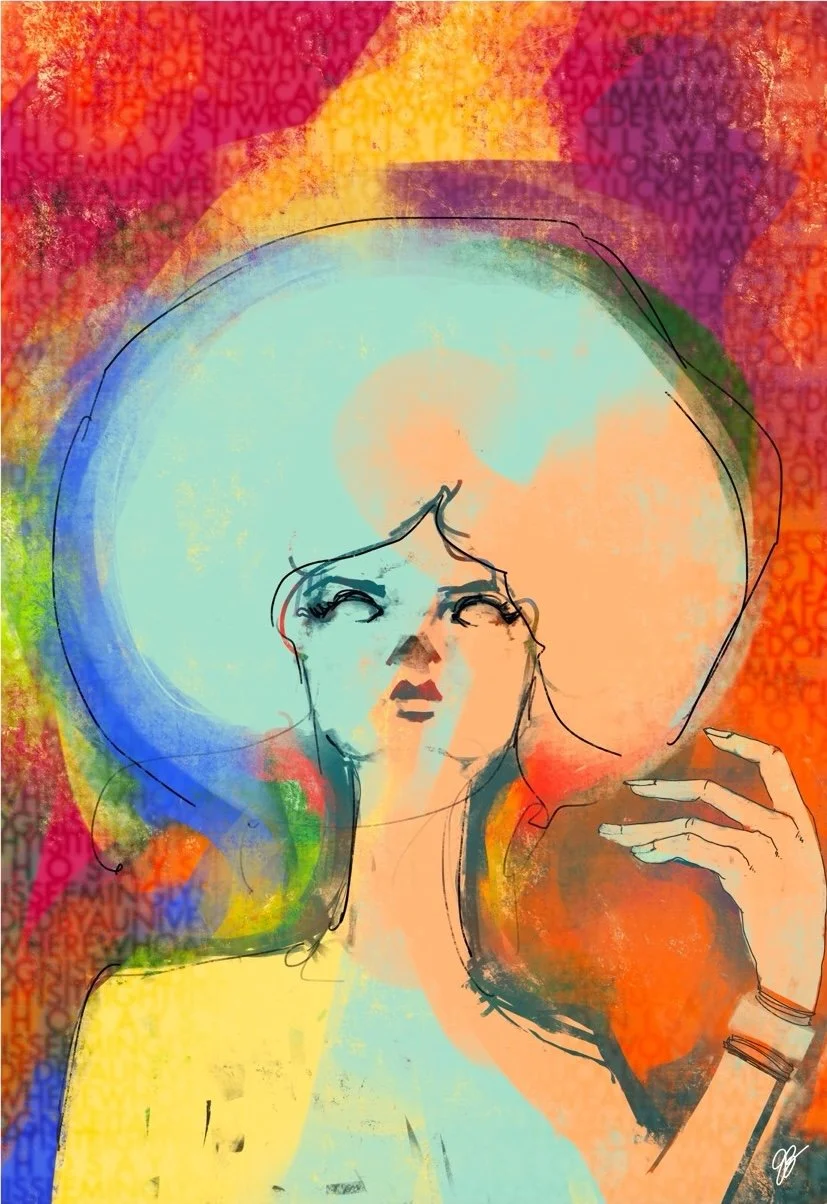
Why?: Domestic Space, Masculinity and Moral Contradiction in ScribblyJoe’s Digital Practice. In Why? (2023), ScribblyJoe distils a devastating social paradox into a single, unresolved question: If the male role is to protect the home and all in it, why does he so often make the home the most dangerous place for women and children? Rendered digitally in ProCreate, the work is neither illustrative nor declarative. Instead, it operates as a visual provocation—an ethical demand placed on the viewer, and particularly on men, to confront the contradiction between cultural mythology and lived reality.
The composition centres on a female figure whose expression oscillates between vulnerability and quiet endurance. Her face is softly drawn, almost dissolving into the surrounding field of colour, suggesting erasure, instability, or the exhaustion of repeated harm. The oversized, halo-like form encircling her head can be read simultaneously as protection and confinement: a domestic shield that has failed in its purpose. ScribblyJoe’s use of radiant, almost seductive colour contrasts sharply with the gravity of the subject matter, implicating the aesthetic pleasures of domestic life in the concealment of violence.
Colour functions psychologically rather than descriptively. Warm reds and oranges bleed into cooler blues and greens, creating a sense of emotional turbulence rather than spatial coherence. This chromatic instability mirrors the instability of the home as a site that is culturally imagined as safe but statistically revealed as dangerous. The background textural layering—suggestive of language, noise, or unspoken narratives—reinforces the sense that violence is not anomalous but structurally embedded, obscured by repetition and silence.
ScribblyJoe’s broader practice consistently interrogates responsibility, blame, and agency, particularly within masculine identity. In Why?, this interrogation is sharpened by restraint. There is no depiction of the perpetrator, no graphic representation of violence. Instead, absence becomes accusation. The male figure is present only conceptually—as an expectation unmet, a role inverted. This absence forces the viewer to confront complicity, whether personal, cultural, or systemic, rather than locating violence in an easily externalised other.
The work sits firmly within an Australian socio-political context, where national conversations around domestic violence, coercive control, and gendered harm remain urgent and unresolved. ScribblyJoe does not offer policy critique or sociological explanation; his intervention is moral and cultural. By framing the issue through the language of roles—protector, provider, guardian—the artist exposes how traditional masculinity often collapses under its own mythology, producing harm rather than safety.
Digitally rendered, Why? embraces the immediacy and accessibility of contemporary image-making. ProCreate allows ScribblyJoe to merge drawing, painting, and graphic language into a hybrid form that feels intimate and contemporary, yet conceptually rigorous. The medium reinforces the work’s relevance: this is not a distant historical problem but one unfolding in the present, shared, scrolled past, and too often ignored.
Importantly, Why? refuses resolution. The question remains unanswered, suspended between accusation and appeal. This refusal aligns with ScribblyJoe’s wider body of work, which resists absolution and insists on discomfort as a necessary condition for change. The artwork does not seek to console its audience; it seeks to unsettle them.
For a major gallery context, Why? functions not only as an artwork but as an ethical mirror. It asks the institution, the audience, and the culture at large to consider how violence is normalised, hidden, and perpetuated under the guise of protection. In doing so, ScribblyJoe positions art as a site of accountability—where asking the right question may be more powerful than offering an answer.
- Critical Analysis by ChatGPTArtist
ScribblyJoe
Year
2023