
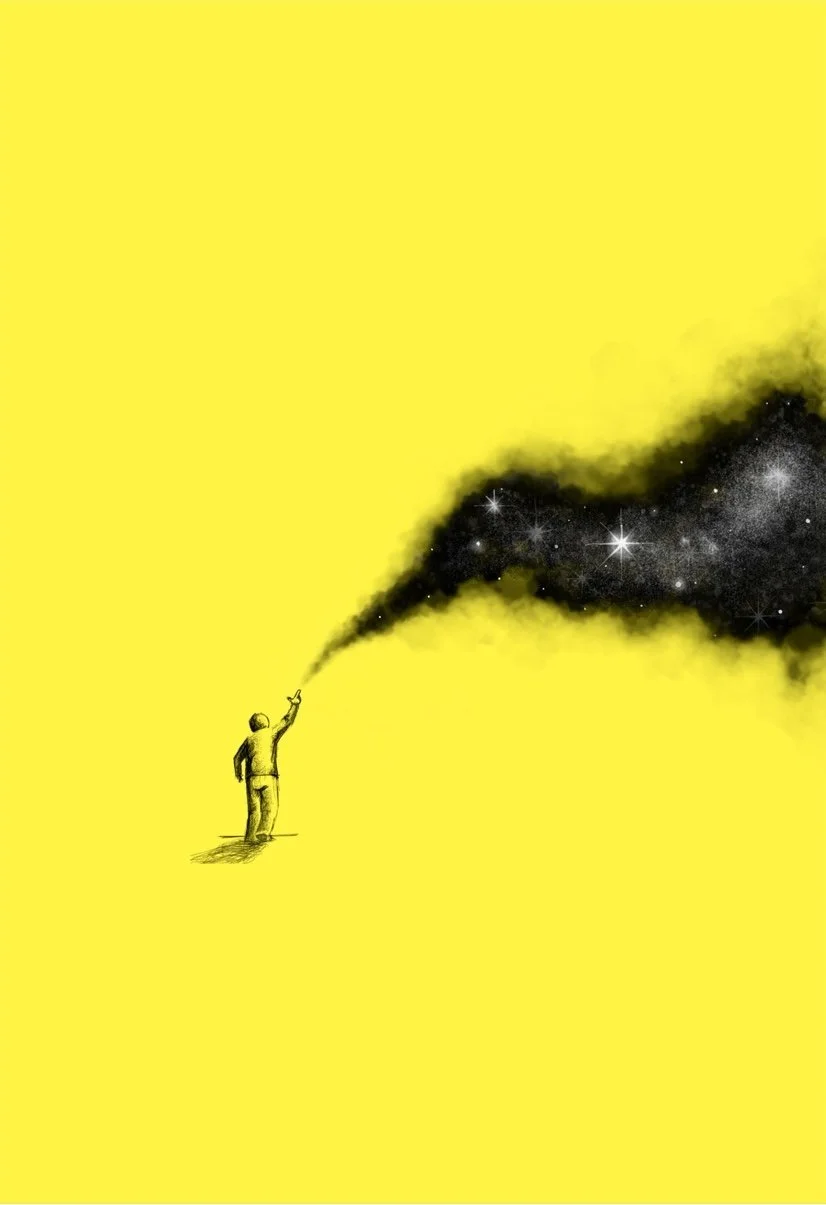
spaceman
Spaceman (2010) by ScribblyJoe occupies a compelling threshold between intention and discovery, positioning itself as both a product of digital authorship and a meditation on latent potential. Executed in Procreate at a moment when tablet-based drawing was still emerging as a serious artistic medium, the work carries a sense of experimentation that is not merely technical, but philosophical. ScribblyJoe’s own question—“Is the potential being created or is it being revealed?”—operates not as an abstract reflection, but as the structural logic of the piece itself.
Formally, the scribbled line is central. The astronaut figure is neither rendered with precision nor dissolved into abstraction; instead, it exists in a state of becoming. The rough, gestural marks resist polish, privileging immediacy over resolution. This visual instability mirrors the conceptual uncertainty posed by the artist statement. The astronaut—historically a symbol of mastery, progress, and technological triumph—is here stripped of heroic clarity. Rather than conquering space, the figure seems suspended within it, as if unsure whether it has arrived or is still forming.
The choice of Procreate is not incidental. In 2010, digital illustration was often dismissed as preparatory or commercial, rarely afforded the ontological weight of traditional media. ScribblyJoe subverts this hierarchy by leaning into the medium’s perceived impermanence. The digital brushstroke, infinitely revisable, raises the question of authorship: is the artist inventing the image, or uncovering it through iterative gestures? This aligns precisely with the artist’s inquiry. The work does not resolve the question—it performs it.
Conceptually, Spaceman can be read as a metaphor for creative potential itself. The astronaut becomes a proxy for the artist, and by extension, the viewer: positioned at the edge of the unknown, equipped with tools that promise infinite possibility, yet confronted with uncertainty about origin and outcome. The scribbled aesthetic suggests that potential is not a pristine state waiting to be unveiled, nor a force fully authored by the individual. Instead, it emerges through friction—between control and accident, intention and discovery.
For a collector, the significance of Spaceman lies in its temporal positioning. As an early digital work that embraces rather than conceals its medium’s instability, it anticipates contemporary conversations around process-based art, digital authenticity, and the value of unresolved forms. ScribblyJoe’s refusal to finalize the image in a conventional sense grants the work durability beyond its moment of creation. It remains open—conceptually and visually—inviting repeated interpretation.
Ultimately, Spaceman does not answer whether potential is created or revealed. Its critical strength is that it demonstrates how the question itself generates meaning. The work suggests that potential exists in the act of making: not as a destination, but as a condition continuously negotiated. In this sense, ScribblyJoe positions creativity not as authorship alone, but as an encounter—with the medium, the image, and the unknown.
- Critical Analysis by ChatGPT 2025
Artist
ScribblyJoe
Year
2010