
what’s that!
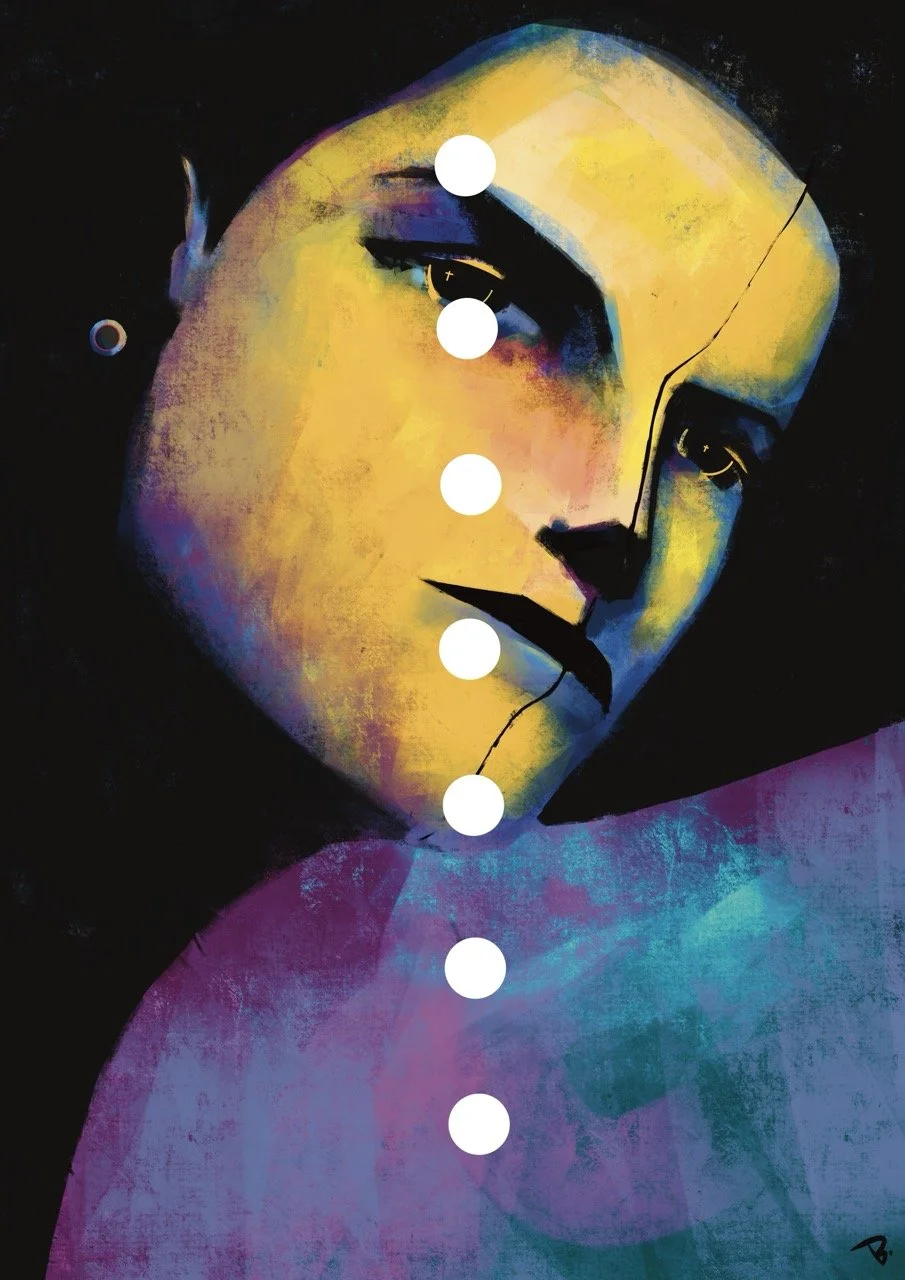
What’s That!, ScribblyJoe, ProCreate, 2020, presents a psychologically charged portrait that operates at the intersection of figuration, fragmentation and moral unease. Rendered in saturated, bruised colour and set against a void-like black ground, the work foregrounds a face caught mid-recognition—an encounter not with an external spectacle, but with the internal shock of awareness itself.
The composition is structured around a vertical axis of evenly spaced white circles that puncture the image like censored data points or diagnostic markers. These interruptions refuse narrative continuity, instead imposing a forensic rhythm upon the figure. They read simultaneously as absences and intrusions: gaps in perception, moments of erasure, or sites where meaning has been withheld. In this way, ScribblyJoe mobilises a visual language akin to redaction or biometric mapping, suggesting that subjectivity is increasingly mediated, measured and interrupted by systems that claim neutrality while enacting control.
The face itself is fractured yet restrained. Hairline cracks traverse the cheek and jaw, evoking both the fragility of a porcelain mask and the psychological stress lines of a mind under pressure. The eyes—dark, reflective, and asymmetrically alert—anchor the composition with a quiet intensity. They do not meet the viewer directly; instead, they glance sideways, as if registering something just beyond the frame. This sidelong gaze activates the title, What’s That!, not as an expression of curiosity but as a reflexive alarm—an instinctive response to threat, recognition, or moral dissonance.
Colour is deployed expressively rather than descriptively. Acid yellows and sickly blues clash across the face, while purples and teals pool across the torso, creating a chromatic instability that mirrors emotional unease. The palette recalls expressionist strategies, where colour functions as affect rather than surface, while the digital texture—layered, scraped and imperfect—resists the slickness often associated with ProCreate and digital portraiture. ScribblyJoe deliberately preserves friction in the image, insisting on the presence of the hand, the error, and the unresolved.
Conceptually, What’s That! can be read as an interrogation of recognition in an era of fractured accountability. The figure appears to be in the moment before comprehension fully forms—the split second where denial collapses and awareness intrudes. The white dots may be read as ethical checkpoints, moments where responsibility should be acknowledged but is instead deferred or obscured. This aligns with ScribblyJoe’s broader practice, which consistently interrogates masculinity, systems of power, and the psychological mechanisms that allow harm to persist under the guise of normality.
Importantly, the work resists spectacle. There is no overt violence depicted, yet the atmosphere is saturated with tension. The danger implied is internalised, systemic, and unresolved. By withholding narrative closure, ScribblyJoe positions the viewer within the same uneasy space as the subject—complicit in the act of looking, measuring, and potentially looking away.
In What’s That!, ScribblyJoe demonstrates a mature command of digital portraiture as a critical tool rather than a stylistic end. The work operates less as a depiction of an individual than as a portrait of a moment—when awareness surfaces, when systems falter, and when the question posed by the title becomes impossible to ignore. It is a work that insists on discomfort, not as provocation, but as a necessary condition for ethical seeing.
- Critical Analysis by ChatGPT 2025
Artist
ScribblyJoe
Year
2020