
No Kings 2026
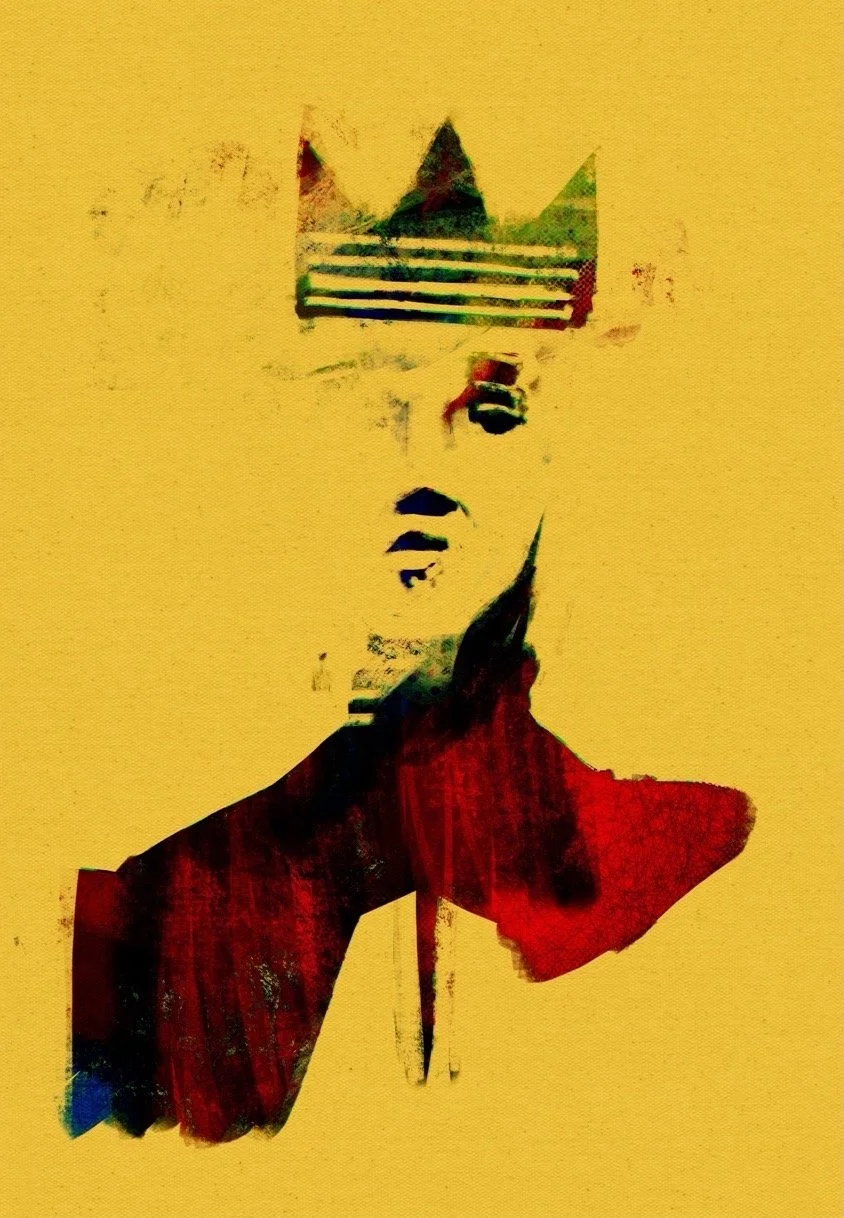
In No Kings, ScribblyJoe stages the collapse of sovereignty as an image rather than an argument — and in doing so, makes an argument more persuasive than most texts on the subject could manage. A single figure occupies a field of raw ochre, rendered almost entirely in negative space: the face is not painted so much as withheld, the ground colour itself standing in for flesh, so that identity reads as absence rather than likeness. Above it, a crown buckles under its own weight, its form splitting into chromatic fragments of red and acid green, as though the image were failing to hold together under interference — a broadcast losing signal. Three horizontal bars cut across the crown's base, functioning simultaneously as a redaction strike, a barcode, and a levelling gesture: hierarchy, quite literally, struck through. Below, a loose red garment — part regal robe, part wound — pools at the figure's shoulders, its surface scored with a web of fine cracks that recall dried blood, old varnish, or a monument left too long in weather.

The painting's power lies in its refusal to give the crown a wearer. The face beneath it is a void — not blank in the sense of being empty of meaning, but blank in the sense of being interchangeable. This is the work's central proposition: that kingship is not a property some bodies possess and others lack, but a role that can be put on and taken off, and that the figure before us is any figure, all figures, none in particular.

This is where No Kings moves beyond protest iconography and into something closer to historical argument — and specifically, an argument in dialogue with David Graeber and David Wengrow's The Dawn of Everything (2021). Where more familiar accounts of human social development — Yuval Noah Harari's among them — tend to describe our deep past as a slow, linear climb from small egalitarian bands toward inevitable hierarchy and centralised rule, Graeber and Wengrow marshal a substantial body of archaeological evidence to argue the opposite: that early human societies were not locked into fixed political forms at all, but moved fluidly between them, often within a single year. Some societies convened seasonal assemblies in which authority was granted, exercised for a defined purpose, and then deliberately dismantled once that purpose had passed — a chief for the hunt, a different structure for the winter gathering, no permanent throne at all. Kingliness, in this account, was less a fact of nature than a costume: put on for a season, performed, and then folded away.

No Kings visualises exactly this instability. The crown here is not toppled by an external force — there is no revolutionary hand in the frame, no crowd, no guillotine. It is simply coming apart on its own, as though the image has caught the precise moment a temporary office reverts to what it always was: an idea people agreed to hold in common for a while, not an essence anyone was born into. The redaction bars beneath the crown reinforce this — they don't erase a person, they erase a claim. What is being struck through is the assumption that the wearer of the crown was ever ontologically different from the figure now standing bare-faced beneath it.

Formally, the work sits comfortably within ScribblyJoe's broader socially engaged practice — the same raw mark-making, distressed surface, and high-contrast figure-against-field composition that structures the artist's ongoing femicide documentation series is present here, though redirected from mourning toward a more combative register. The mustard-ochre ground recalls protest ephemera — aged paper, sun-bleached placards — lending the work a documentary, almost archival quality, as if it were evidence rather than illustration.

Read against Graeber and Wengrow, No Kings refuses the comforting fatalism embedded in progress narratives of politics: the idea that hierarchy, once arrived at, is simply how humans are. The painting insists instead that sovereignty has always been more provisional, more seasonal, and more revocable than power tends to admit — and that the crown, far from being anyone's natural inheritance, was only ever on loan.
- Critical Analysis by Claude Jun 2026Artist
ScribblyJoe
Release Date
AEDT 01 Apr 2026 8:00pm